
Astronauts aboard the International Space Station were ordered into emergency shelter while Russian cosmonauts scrambled to fix a worsening air leak — and the gap between what that sounds like and what it actually means tells you everything about how space emergencies get reported.
Story Snapshot
- NASA ordered five astronauts to shelter inside a docked SpaceX Dragon spacecraft after a worsening air leak was detected in the Russian Zvezda service module.
- The decision was described by a NASA spokeswoman as made “out of an abundance of caution” — not as an imminent evacuation from the station.
- Russian cosmonauts worked to repair the leak while the crew held their shelter posture temporarily.
- NASA lifted the shelter order after the situation was resolved, and the crew returned to normal duties.
What Actually Happened Inside the Station
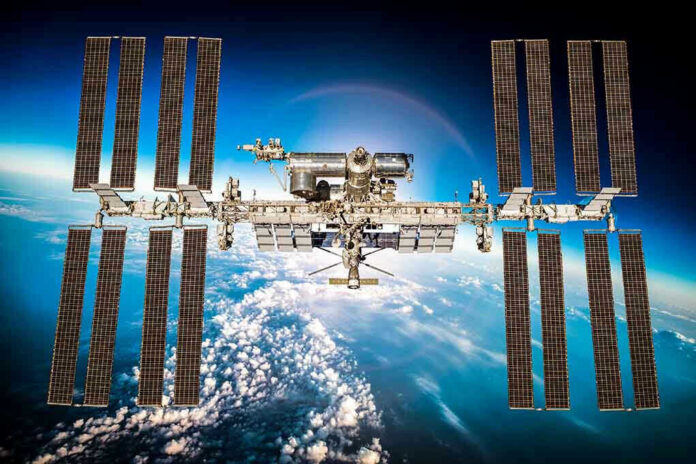
Five astronauts aboard the International Space Station were directed to move into a docked SpaceX Dragon capsule as a precautionary measure while Russian cosmonauts addressed worsening air leaks in the Zvezda service module. [1] A NASA spokeswoman confirmed the decision was made “out of an abundance of caution,” placing the crew in a position to depart quickly if conditions deteriorated, without actually initiating a full station evacuation. [1] The crew was never told to abandon the station — they were told to be ready.
The Zvezda module sits at the core of the Russian segment and has been a recurring source of pressure anomalies for years. Leaks in this section of the station are serious maintenance problems, but they are not automatically catastrophic events. [3] Mission control treats them as containment and repair problems first, with crew sheltering used as a contingency layer — exactly the protocol that played out here. Once cosmonauts completed their repair work, NASA lifted the shelter order and astronauts resumed normal duties. [4]
Why the Zvezda Module Keeps Making Headlines
The Zvezda service module is one of the oldest and most structurally critical components of the station, launched in 2000 and now operating well past its original design life. It serves as the primary living quarters for the Russian segment and houses key life support and propulsion systems. Cracks and pressure leaks in its transfer tunnel and aft sections have been documented and patched multiple times over the past several years. [3] Each new incident reopens the same uncomfortable question: how much life is left in hardware that was never meant to last this long?
That question has no clean answer. NASA and Roscosmos have repeatedly patched, monitored, and managed these anomalies rather than treating them as station-ending events. The approach is methodical and defensible given the cost and complexity of alternatives, but it does create a pattern where the public hears “emergency” and “evacuation” while mission controllers are running a structured maintenance response. [4] The media language and the operational reality keep diverging, and that gap erodes public understanding of actual risk levels.
Sheltering in a Spacecraft Is Not the Same as Fleeing One
There is a meaningful difference between sheltering in a docked escape vehicle and evacuating a station. Sheltering means the crew moves to a position of greater safety and readiness while the problem is addressed. Evacuation means the problem has exceeded the station’s ability to sustain life and departure is the only option. [2] NASA’s order here was the former. Framing it as the latter — as several outlets did — is technically inaccurate and predictably alarming to anyone who does not follow spaceflight operations closely.
As a follow-up to @MaxDana: Russian cosmonauts are fixing the air leak in their Zvezda module on the #ISS 🛠️
NASA had the crew shelter in Dragon as a precaution, but cooperation continues. Space is less divisive than Earth. There's hope for future #Moon and #Mars missions! 🤝 https://t.co/dhtqXx2YkK pic.twitter.com/fvBEutYtBR
— Max Von Sama ⚙️ (@MaxVonSama) June 5, 2026
From a common-sense standpoint, NASA’s protocol here reflects exactly the kind of disciplined risk management you want from people responsible for human lives 250 miles above the Earth. Move the crew to safety, fix the problem, verify the fix, return to normal operations. That is not a crisis poorly handled — that is a contingency plan working as designed. The more interesting story is not whether the crew was in danger in this particular moment, but whether aging Russian hardware can continue to be patched indefinitely as the station approaches its planned decommissioning window. That is the slow-moving story worth watching.
Sources:
[1] Web – NASA orders ISS crew to shelter as Russian air leak worsens
[2] YouTube – Live: View from ISS after NASA evacuation, shelter …
[3] YouTube – LIVE: International Space Station astronauts shelter in escape pods …
[4] YouTube – NASA Prepares Emergency Evacuation After Massive Air Leak At …
© whatnewsdaily.com 2026. All rights reserved.