
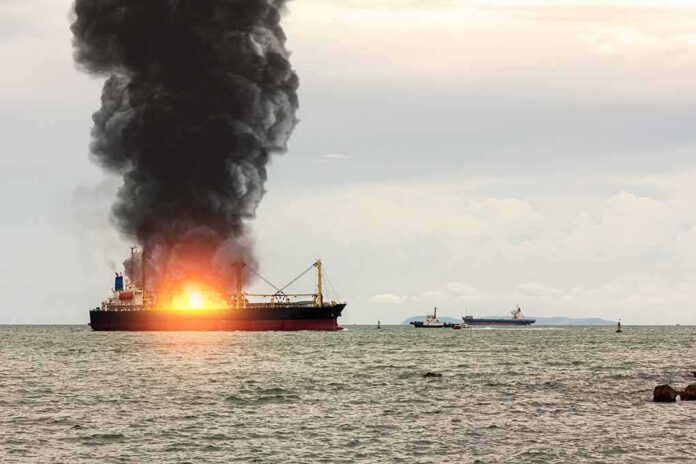
U.S. forces disabled three Iranian-flagged oil tankers in the Gulf of Oman after repeated warnings, enforcing a declared blockade against Iran’s ports, according to U.S. Central Command.
Story Highlights
- CENTCOM says U.S. forces disabled three Iranian-flagged tankers headed toward Iranian ports after warnings were ignored.
- The first tanker’s rudder was hit by cannon fire from a Navy F/A-18; two more were stopped with precision strikes to their smokestacks.
- All three vessels halted their transits toward Iran, which CENTCOM says shows the operation worked.
- Major outlets echoed CENTCOM’s account as markets watched energy routes near Hormuz closely.
What CENTCOM Says Happened at Sea
U.S. Central Command (CENTCOM) reported that on May 6, U.S. forces disabled an Iranian-flagged, unladen tanker named M/T Hasna in the Gulf of Oman after multiple warnings went unanswered. CENTCOM said the ship was moving in international waters toward an Iranian port and was violating a U.S. blockade. A U.S. Navy F/A-18 Super Hornet launched from the carrier USS Abraham Lincoln fired 20 millimeter cannon rounds that disabled the tanker’s rudder, stopping its approach toward Iran, according to the release.
CENTCOM then said two more Iranian-flagged tankers, M/T Sea Star III and M/T Sevda, were disabled on May 8 as they neared an Iranian port in the Gulf of Oman. U.S. forces used precision munitions to strike their smokestacks, which CENTCOM described as a targeted method to stop propulsion without sinking the ships. The command stated that all three vessels ended their transits toward Iran after these actions, underscoring the enforcement effect of the operation. CNBC and other outlets reported the U.S. military announcement and its focus on blockade enforcement.
How the Blockade and Warnings Were Applied
CENTCOM’s description emphasizes graduated steps: identify the ship, issue radio warnings, and act only after noncompliance. The first action disabled steering; the next two targeted power and exhaust to halt movement. The command framed each strike as limited and precise, focused on stopping the approach to Iranian ports without risking large oil spills or crew casualties. CENTCOM has also highlighted other maritime security actions in the area, including boardings and course redirections, to show a broader pattern of enforcement.
The locations sit near one of the world’s tightest energy chokepoints. Traffic through the Gulf of Oman connects to the Strait of Hormuz, where global oil shipments are vulnerable to any disruption. Reports throughout 2026 catalogued incidents in these waters, including explosions, projectile strikes, and vessel seizures by Iranian forces or unknown actors, adding to tension and risk for shippers and insurers. That backdrop helps explain why the Pentagon moved to stop ships it said were violating the blockade.
Why This Matters to American Security and Energy Prices
President Trump’s administration has pledged to keep sea lanes open, deter Iran’s aggression, and protect American forces and partners. CENTCOM’s account presents these tanker actions as part of that mission: clear warnings, measured force, and a result that halted suspect movements without sinking ships. Major financial and news outlets tracked the U.S. announcement because oil markets often react to any threat near Hormuz. Even the hint of risk can raise costs for families, truckers, and small businesses that rely on fuel.
Conservatives expect the government to defend U.S. interests firmly and to avoid the empty talk that invites more danger. This episode shows American pilots, sailors, and commanders acting with purpose. They delivered practical results while trying to limit collateral damage. That aligns with a simple standard: peace through strength, and strength with discipline. It signals to Iran’s leadership that using civilian-flagged ships to test U.S. lines will meet real consequences, not press releases.
Known Facts, Open Questions, and the Wider Pattern
The public record here includes named ships, dates, the methods used to disable them, and the claimed outcomes, all attributed to official CENTCOM statements and echoed by recognized outlets. Reuters also reported separate tanker incidents in the same region where the cause was described as unknown, showing how busy and dangerous the waters have been this year. That broader context does not change what CENTCOM reported, but it reminds readers the area is complex and often contested by many actors.
For now, the through-line is clear: U.S. forces warned, then acted; three Iranian-flagged tankers stopped their push toward Iranian ports; and the U.S. maintained pressure on routes that Tehran uses to project power. As more official details emerge, the core takeaway remains the same. The Navy has the reach, skill, and rules to defend our interests and keep bad actors guessing. That is how you keep pressure off American wallets at the gas pump and off American troops on the front lines.
Sources:
insiderpaper.com, centcom.mil, engine.online
© whatnewsdaily.com 2026. All rights reserved.