

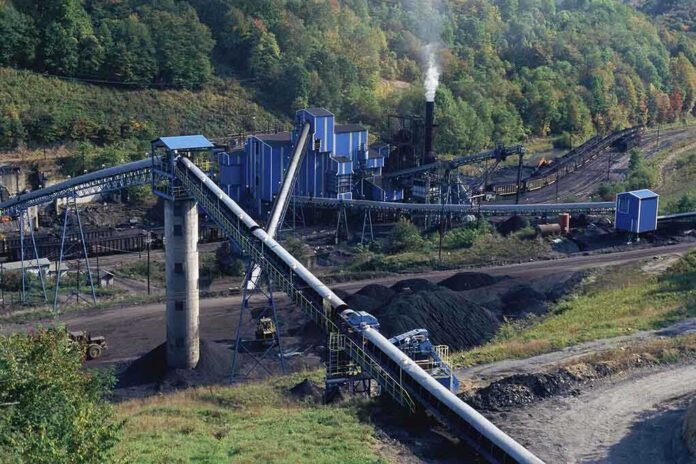
A revived “beautiful, clean coal” push is about to send $700 million in federal firepower into plants and a new export terminal, with Trump betting big that coal still matters for America’s energy security and jobs.
Story Snapshot
- President Trump plans nearly $700 million to upgrade coal plants and build a new export terminal using defense authorities.
- Supporters say the plan protects grid reliability, national security, and high-paying blue-collar jobs in coal country.
- Critics blast it as a subsidy for a declining industry that could raise consumer costs and slow the shift to other energy sources.
- The money is largely repurposed from earlier clean-energy and carbon-capture funds, not brand-new spending.
Trump’s $700 Million Coal Package: What Is Being Funded?
White House officials say President Trump will direct roughly $700 million in federal support toward upgrading existing coal plants and helping finance at least one new coal export terminal, using powers under the Defense Production Act.[1][3] Of that amount, more than half is expected to go to modernization and life-extension projects at 13 coal-fired power plants, with about $185 million structured as matching funds to leverage additional private investment into new or expanded coal facilities, including the export terminal.[1][3] Supporters frame the package as a targeted boost rather than an open-ended bailout.
Energy Department notices and administration briefings describe the plan as focusing on “restart, overhaul, or retrofit” work at older coal stations that had been slated for retirement or deep output cuts.[2][3] Some of the spending will cover upgrades to turbines, boilers, and pollution-control equipment to keep units online longer, while other dollars will go toward connecting those plants more firmly into regional grids that are straining under artificial intelligence data centers and electrification demand.[2] A separate tranche will support engineering and early construction at a Gulf Coast coal export terminal to expand overseas sales.[3]
National Security, Jobs, And Grid Reliability Arguments
The Trump White House has already framed coal as a strategic asset, issuing a fact sheet calling America’s coal fleet “beautiful” and “clean” and tying it directly to uninterrupted power for military bases and other critical defense sites. An executive order directed the Department of War to prioritize long-term power purchase agreements with coal plants to guarantee on-demand baseload electricity for those facilities, explicitly linking coal to national security and deterrence. The new $700 million package is being presented as a concrete extension of that strategy rather than a standalone jobs program.
Administration supporters argue that coal remains one of the few fuel sources that can provide 24/7 power independent of foreign supply chains, intermittent weather, or fragile just-in-time fuel logistics. They also say coal’s ability to store weeks of fuel onsite hardens the grid against cyberattacks, hurricanes, and geopolitical crises that could disrupt natural gas pipelines or imported materials for solar and wind farms. From this perspective, subsidizing coal plants and an export terminal is cast as insurance for both domestic stability and America’s role as an energy superpower, even as other sources grow.
Blue-Collar Paychecks And Coal Country Politics
The Energy Department has repeatedly highlighted coal’s role in supporting high-paying, often union or skilled-trade jobs in rural and small-town America that were hammered during the previous decade’s “war on coal.” Earlier Trump-era moves to end that “war” included lifting barriers to mining on federal lands, redesignating coal as a mineral, and channeling hundreds of millions of dollars into coal plant upgrades so owners could reverse retirement decisions. Officials now say the $700 million package will sustain and potentially expand those job gains by stabilizing plants and promoting export growth, particularly in Appalachia and parts of the Midwest.
Some of the new funding appears to build on earlier commitments like the $175 million modernization package for six coal plants, including two in Ohio, which was justified as a response to surging electricity demand from artificial intelligence data centers and industrial reshoring.[2] That earlier initiative was described as helping aging, debt-laden plants stay open, support local tax bases, and avoid reliability shortfalls as factories and server farms plug into the grid.[2] The larger $700 million effort scales up that model, potentially extending it to more states and adding export infrastructure that could keep miners and rail workers employed as well.
Critics Warn Of High Costs And A Short-Term Lifeline
Environmental and consumer advocates counter that the coal package looks less like a long-term industrial strategy and more like a repurposing of existing funds to temporarily prop up an industry facing structural decline.[2] Reporting on Energy Department documents indicates that about $525 million is being redirected from previously unobligated carbon-capture and clean-energy demonstration programs created under a bipartisan law, rather than new appropriations debated openly in Congress.[2] Critics argue that this approach shifts money away from next-generation technologies and toward keeping older coal facilities running a few more years.
Trump expected to announce $425M in government funding for 13 existing US coal plants plus $185M to build two additional plants.
— The Dive Feed (@TheDeepDiveFeed) June 4, 2026
An independent analysis of earlier Trump directives to keep coal plants operating found that such orders could increase consumer costs by billions of dollars over time, primarily by forcing grid operators to buy power from more expensive generators. Groups opposing the new package warn that similar dynamics could play out again if defense or emergency authorities effectively guarantee revenue streams for coal even when cheaper options are available. They frame the $700 million as a subsidy that masks market signals, slows the energy transition, and leaves ratepayers covering the difference so specific plant owners and regions can benefit.
Sources:
[1] Web – Trump plans $700 million investment in new coal plants and terminal
[2] YouTube – Trump directs Pentagon to buy electricity from coal plants
[3] Web – Trump admin redirects carbon capture funds to prop up old coal plants
© whatnewsdaily.com 2026. All rights reserved.