
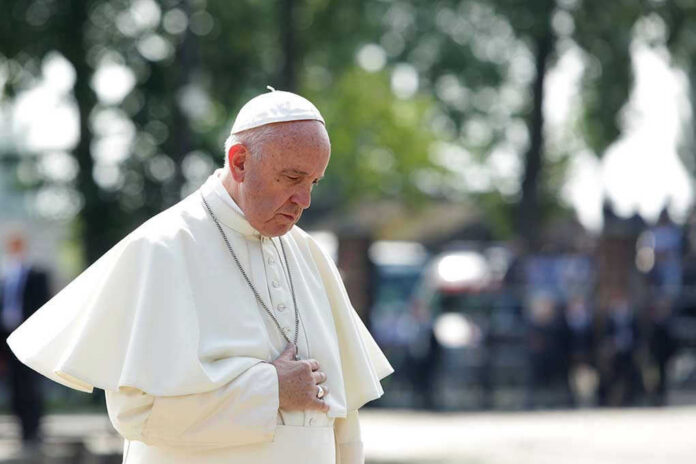
President Donald Trump publicly declared “I’m not a fan of Pope Leo,” launching an unprecedented assault on the first American pope over nuclear weapons, crime policy, and Venezuela that exposes a widening chasm between presidential power and spiritual authority.
Story Snapshot
- Trump attacked Pope Leo XIV as “weak on crime” and overly liberal after the pontiff criticized U.S.-Israel military action in Iran as driven by “delusion of omnipotence”
- The president accused Leo of supporting Iran’s nuclear ambitions and claimed the pope’s election was orchestrated to counter his own presidency
- This rare public feud erupted during fragile U.S.-Iran ceasefire negotiations in Pakistan and following U.S. military strikes on Venezuela
- Trump positioned himself against the spiritual leader of 1.3 billion Catholics while courting evangelical supporters who claim divine backing for his Iran policy
- Analysts describe the presidential rebuke as “exceedingly rare” and “extraordinary” in the history of U.S.-Vatican relations
When Presidents Attack Popes
Trump’s tarmac tirade against Pope Leo XIV on Sunday evening marked a stunning escalation in church-state tensions. Fresh off a flight from Florida to Washington, the president told reporters that Leo represents everything wrong with modern religious leadership. Trump’s critique extends far beyond theological disagreement into pointed accusations about national security and domestic crime policy. The president framed Leo as a liberal ideologue who prioritizes “the Radical Left” over American safety, particularly regarding Iran’s nuclear program and Venezuelan drug trafficking.
The timing reveals strategic calculation. Trump’s broadside followed Pope Leo’s Saturday evening prayer service at St. Peter’s Basilica, where the pontiff suggested that “delusion of omnipotence” fuels the ongoing U.S.-Israel military campaign in Iran. These comments landed precisely as American negotiators sat across from Iranian counterparts in Pakistan, attempting to solidify a fragile ceasefire. Leo’s critique of U.S. strikes on Venezuela over drug trafficking added fuel to Trump’s fury, prompting the president to question whether America wants “a pope that’s going to say that it’s okay to have a nuclear weapon.”
The First American Pope Faces American Power
Pope Leo XIV’s American origins add extraordinary complexity to this confrontation. Trump claims Leo’s papacy itself represents a Vatican power play, asserting “If I wasn’t in the White House, Leo wouldn’t be in the Vatican.” This remarkable allegation suggests the president views the pope’s election as strategically designed to manage U.S. relations during his second term. Whether this reflects genuine intelligence or political posturing, it demonstrates Trump’s willingness to challenge institutional narratives that most presidents would leave unquestioned. The president’s evangelical base provides crucial insulation from Catholic backlash.
The substantive divide centers on competing visions of American strength. Trump champions aggressive deterrence against nuclear proliferation and military action against drug trafficking networks, positions that resonate with his “America First” mandate from the 2024 election. Leo advocates for diplomatic restraint and peace initiatives that Trump characterizes as weakness. This philosophical split mirrors broader tensions within American conservatism itself, where hawkish foreign policy traditionalists increasingly clash with religious voices emphasizing restraint and humanitarian concerns over military solutions.
Political Calculations Behind the Clash
Trump’s attack serves multiple political objectives simultaneously. By branding Leo as weak on crime and sympathetic to Iranian nuclear ambitions, the president reinforces his tough-on-crime credentials while deflecting potential criticism of his Iran policy. The Venezuela dimension allows Trump to pivot to border security and drug enforcement, perennial strengths with his base. Positioning the pope as part of the “Radical Left” helps consolidate evangelical Protestant support, a demographic that delivered crucial margins in 2024 and views papal pronouncements on American foreign policy with suspicion.
The absence of any Vatican response creates an information vacuum Trump fills with his own narrative. Pope Leo’s silence might reflect careful diplomatic calculation or internal deliberation about engaging a combative president. Either way, Trump controls the messaging cycle, a familiar dynamic from his first term. Analysts at America Magazine describe the confrontation as extraordinary precisely because modern popes typically avoid direct engagement with presidential attacks, preferring to maintain moral authority through restraint. Trump’s strategy depends on Leo continuing this pattern while Trump himself faces no such constraints.
Implications for Catholics and Conservatives
This dispute forces American Catholics into uncomfortable political territory. Many conservative Catholics supported Trump’s judicial appointments and pro-life policies while maintaining deep respect for papal authority. Leo’s peace advocacy appeals to Catholic social teaching traditions, yet Trump’s critiques of weakness on crime and nuclear proliferation resonate with security-minded believers. The fragmentation could reshape Catholic voting patterns if the conflict persists, potentially pushing culturally conservative Catholics toward either explicit papal loyalty or deeper alignment with Trump’s nationalist conservatism divorced from Vatican guidance.
The broader conservative movement watches closely. Trump’s willingness to attack a sitting pope demonstrates his conviction that political power trumps institutional deference, a principle that animates his entire approach to governance. Whether this represents healthy skepticism of unelected moral authorities or dangerous disregard for spiritual leadership depends entirely on one’s view of papal legitimacy in political matters. What remains clear is that Trump sees no downside in this confrontation, confident his base values strength over ecclesiastical courtesy. The Iran ceasefire negotiations continue regardless, suggesting realpolitik proceeds independent of religious pronouncements.
Sources:
Trump slams Pope Leo, says ‘I’m not a fan’ over crime and nukes