
Trump’s workaround to pay furloughed TSA agents may get travelers moving again, but it also exposes how easily Washington’s budget games can push basic federal functions to the brink.
Story Snapshot
- President Trump signed an executive order on March 27 to repurpose funds tied by a “reasonable and logical nexus” to TSA operations so agents could be paid during the DHS funding lapse.
- DHS Secretary Mark Wayne Mullen said paychecks could arrive as soon as Monday or Tuesday, offering immediate relief to workers and their families.
- Airport delays were expected to ease as staffing stabilizes, though airports continued urging travelers to arrive 2–3 hours early.
- The move provides partial relief while broader DHS functions remain strained without a full funding deal.
Trump’s executive order targets TSA pay as airport lines spike
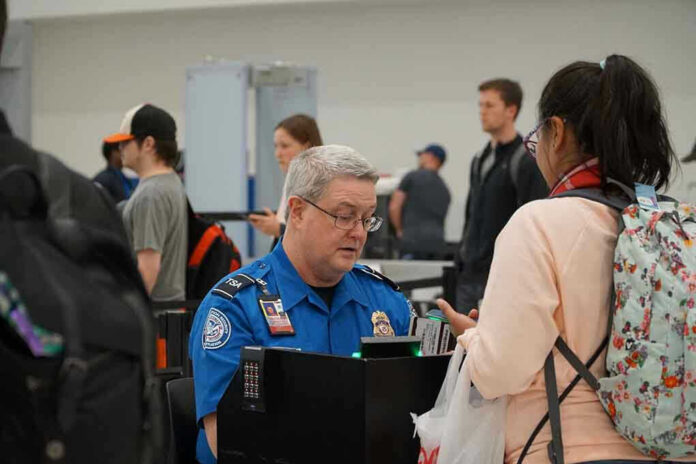
President Donald Trump signed an executive order Friday, March 27, directing the administration to repurpose certain federal funds to cover Transportation Security Administration pay during the Department of Homeland Security funding lapse. The immediate goal was to stop the cascade of staffing problems that led to long security lines at major airports. Reporting indicated absenteeism reached levels described as up to 40% in some locations, worsening wait times and missed flights.
The plan, as described in administration briefings and televised reporting, relies on shifting money that has a “reasonable and logical nexus” to TSA operations. That language matters because it signals the White House is trying to keep the move inside defensible boundaries while Congress remains deadlocked. The order does not fully reopen DHS, but it is designed to get agents paid quickly enough to restore normal staffing and reduce disruptions for travelers.
DHS says checks could arrive within days, but the shutdown fight isn’t over
DHS Secretary Mark Wayne Mullen said the department’s plan was to get TSA agents paid “hopefully by tomorrow or Tuesday,” describing the news as important because employees were “struggling.” The timeline placed the first paychecks as soon as Monday, March 30, depending on implementation. The administration message was simple: paying agents now is necessary to keep airports functioning, even if Congress is still fighting over a broader package.
Congressional gridlock forces executive improvisation
The shutdown dispute centered on DHS funding, including TSA, FEMA, and the Coast Guard. A Senate-approved funding bill moved late Friday, but the broader effort still ran into resistance in the House, where Republicans rejected the Senate bill as a “joke,” according to the available reporting. The result was a familiar Washington pattern: critical services get dragged into leverage politics, and the executive branch is pressured to improvise.
For conservative voters who remember years of fiscal chaos, this episode cuts two ways. The executive order is a practical step to keep airports from melting down, but it also underscores how quickly “temporary” shutdown brinkmanship turns into a public-safety and economic problem. When travelers are told to show up hours early and workers are unsure when they’ll be paid, the system is not functioning the way taxpayers expect.
What travelers and TSA families are seeing on the ground
Airports and airlines continued advising passengers to arrive two to three hours early, even as expectations grew that lines would ease once pay restarted. Travelers interviewed in reporting framed the issue in human terms: TSA agents have families, rent, and bills, and unpaid work eventually breaks morale. That practical reality drove call-outs and staffing gaps, and it is why a paycheck schedule can change airport conditions faster than any political speech.
Constitutional and policy questions raised by shifting funds
Repurposing money by executive action can raise legitimate constitutional concerns, because Congress controls appropriations and voters expect lawmakers to do their jobs rather than outsourcing crisis management to the White House. The reporting available does not provide legal analysis or court challenges tied to this specific order, so the strength of any claim that it violates appropriations law remains unclear. What is clear is that this is a stopgap, not a durable solution.
Dems Outfoxed Again: Airports Returning to Normal As Trump Finds Way to Pay TSA Agentshttps://t.co/WxjwXMSPqT
— RedState (@RedState) March 30, 2026
The bigger takeaway for taxpayers is that partial fixes can normalize dysfunction. Paying TSA agents may stabilize airports, but other DHS components still depend on a full funding agreement. FEMA readiness and Coast Guard operations are not the kind of functions the country can casually leave in limbo. If Congress cannot pass a straightforward funding bill, executive workarounds will keep multiplying—and that is not a healthy long-term precedent for limited government.