
Secretary of State Marco Rubio said the United States must keep talking with China, calling it reckless and irresponsible not to maintain the relationship.
Quick Take
- Rubio said the United States and China “have to have a relationship” because they are two of the world’s most powerful countries.
- He said open dialogue is needed to keep differences from spinning out of control.
- His remarks came as he met Chinese Foreign Minister Wang Yi on the sidelines of an Asian regional meeting.
- The comments fit a broader pattern in Washington: rivalry with Beijing, but also steady contact to reduce the risk of conflict.
Rubio Presses for Managed Tensions
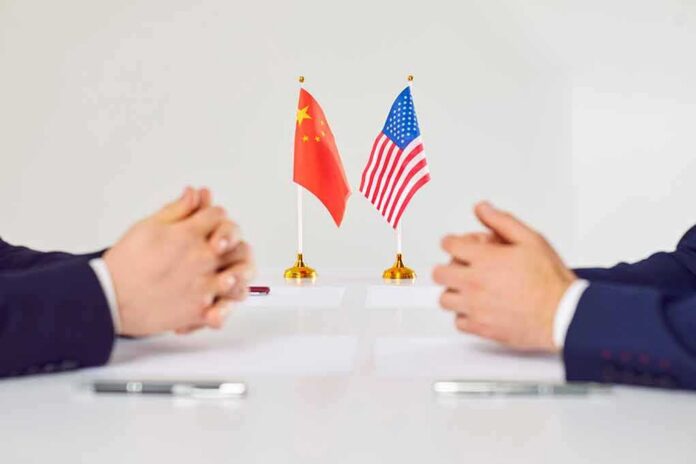
Rubio made the case in Manila that the United States and China cannot afford a break in communication. He said both countries are major economic and military powers and must work through their differences. The message was firm but practical. He did not suggest that the two sides agree on core issues. He said they still need a channel to keep disputes from becoming larger crises.
That position matched other recent comments from Rubio, who has said the lack of communication could lead to conflict and that strategic stability matters even when the two governments remain at odds. Reporting on the meeting described his tone as cordial, with both sides stressing the need to manage tensions ahead of President Donald Trump’s expected meeting with Chinese President Xi Jinping. Rubio’s public line was consistent: competition is real, but dialogue is still required.
Why the Timing Matters
The remarks landed during a period of heavy diplomacy around Asia and before a planned Trump-Xi summit. That gives the exchange more weight than a routine press note. Washington and Beijing are trying to keep trade, security, and regional disputes from spilling into a wider clash. Rubio’s comments suggest the administration sees value in direct contact even while it keeps pressure on China in other areas. For many voters, that mix reflects a hard truth about power politics.
It also reflects a frustration shared across party lines. Many Americans want a tougher stance on China, but they also want leaders who can avoid reckless escalation. Rubio’s language leaned into that concern. He described the relationship as one that must be handled carefully, not cut off. That approach does not erase the rivalry. It does show that even the most hawkish officials recognize the cost of a total breakdown in communication.
What the Exchange Signals Next
Rubio’s comments are part of a broader pattern in which U.S. officials try to balance deterrence with direct talks. That balance matters because the two countries are deeply tied together through trade, security, and global influence. The challenge is not finding common ground on everything. It is keeping disputes from turning into a crisis neither side can control. Rubio’s remarks suggest that, for now, Washington wants pressure without silence.
Secretary of State Marco Rubio says maintaining a working relationship with China requires a "delicate balancing act."
He warns that any military or economic conflict between the U.S. and China would be "catastrophic" for both countries and the world.
Rubio adds the U.S. must… pic.twitter.com/rTZQNUyZQm
— Fox News (@FoxNews) August 2, 2026
The immediate test will be whether the talks produce more than warm words. The meeting with Wang Yi showed that both sides are still willing to sit down and speak. That alone matters in a tense relationship where small misunderstandings can carry large costs. Rubio’s message was plain: the United States will compete with China, but it will not walk away from the table. That is the kind of realism many Americans say they want from Washington.
Sources:
facebook.com, state.gov, washingtonpost.com, china.usembassy-china.org.cn, en.wikipedia.org
© whatnewsdaily.com 2026. All rights reserved.