

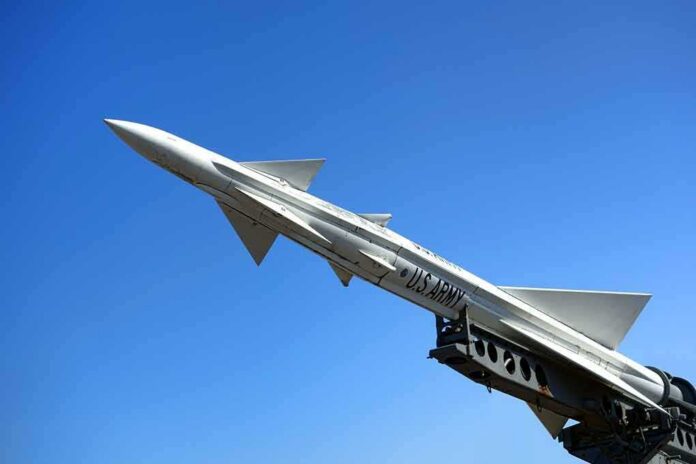
America’s missile shield is running low at the very moment experts say it could take years to refill, leaving a dangerous gap in U.S. defenses.
Story Snapshot
- Analysts say refilling Patriot and Terminal High Altitude Area Defense missiles to pre‑war levels will likely take at least three years.
- The Iran war burned through a huge share of advanced interceptors, exposing how slowly the U.S. defense industry can replace them.
- President Trump’s Patriot license for Ukraine highlights workarounds on production, but it does not fix America’s own stockpile problem quickly.
- These long delays deepen public fears that Washington protects foreign wars and defense contractors before it secures the American homeland.
Missile Stockpiles Drained Faster Than They Can Be Rebuilt
Defense planners now admit that key U.S. missile defenses were burned down to worrisome levels during the recent war with Iran. Patriot and Terminal High Altitude Area Defense interceptors were fired in large numbers to shield troops, bases, and allies from Iranian drones and ballistic missiles. Experts who studied the numbers say those interceptors cannot be “replaced overnight” and that the restock process will take years, not months. This mismatch between use and resupply is at the heart of today’s alarm.
A detailed study by the Center for Strategic and International Studies (CSIS) found that, under current Pentagon delivery plans, Patriot and Terminal High Altitude Area Defense inventories will need three or more years just to get back to where they were before the Iran war. That timeline depends on contracts already in place and assumes no new major conflict drains stockpiles again. In plain terms, the United States has created a multi‑year window where its missile shield is thinner, while rivals like Iran and China are watching closely.
Three‑Year Rebuild Is a “Conservative” Estimate
Independent defense analysts warn that even the three‑year figure may be the best‑case scenario. One expert from the Project on Government Oversight called three years a “conservative estimate” and argued that real replenishment will probably take much longer. He pointed out that production surge agreements with companies for these complex interceptors often take three to seven years before higher output fully kicks in. That means Washington has chosen a system where the nation can fire missiles in weeks but only refill them in half a decade.
CSIS data backs up this concern by showing that several missile types used in the Iran conflict, including Patriot and Terminal High Altitude Area Defense, have replacement timelines stretching out toward 2029 and 2030. A public broadcast based on the same work noted that these interceptors will take “three or more years” to reach pre‑war stocks and even longer to reach levels planners say they truly need. For citizens on both the right and the left who already distrust federal planning, this feels like yet another case where elites ignored obvious risks until it was too late.
Trump’s Patriot License for Ukraine and What It Reveals
At the NATO summit in Ankara, President Trump tried to show action by promising Ukraine a license to produce Patriot interceptor missiles. Standing beside Ukrainian President Volodymyr Zelenskyy, he said, “We’re going to give a license to you to make Patriots.” That offer is a major political win for Kyiv, which has begged for more air defense as Russia keeps striking its cities. It also quietly confirms that existing U.S. production lines are too limited, forcing Washington to look abroad for added capacity.
Zelenskyy later said the two countries had reached a “political agreement” on the licenses and urged technical teams to move “without delay” so Ukraine could start producing interceptors as soon as possible. But reporting from outlets such as the Associated Press and Defense News stresses that turning this license into real missiles will likely take years. There are export rules, complex parts, and corporate approvals to clear. Even Lockheed Martin’s support for the idea does not erase those hurdles. In other words, both America’s own restock and the Ukraine license are trapped inside the same slow‑moving defense industry.
Why This Fuels Public Distrust in Washington
For many Americans, these facts feed a deep sense that the federal government is failing at basic jobs. Citizens see a Pentagon that can spend historic sums, including budgets well above a trillion dollars, yet still cannot quickly refill the very missiles that defend U.S. troops and allies. They watch leaders promise new deals in Europe while quietly accepting a years‑long vulnerability at home. To people who already believe the system serves defense contractors and the “deep state” first, this looks like another example of elites protecting their own interests.
Promises Alone Do Not Build Patriot Missiles
Again, this is another example of rhetoric being ahead of reality.
It does not matter what Donald Trump or any other politician says if the companies that own the technology are unwilling to transfer it. Patriot missile production is…
— Nordexium (🇫🇷 🇩🇰) (@Nordexium) July 30, 2026
Experts warn that this gap in missile defenses matters most if a new crisis erupts, especially with China over Taiwan. CSIS notes that Patriot and Terminal High Altitude Area Defense stockpiles will not be fully rebuilt until around 2029, even as Chinese leaders tell their military to be ready for Taiwan years earlier. That timing feels reckless to many on both sides of the political divide. Conservatives see it as proof that globalist wars and wasteful spending have weakened America’s shield. Liberals see it as another sign that Washington ignores long‑term security while inequality and instability grow at home. Both can agree on one thing: a government that lets vital defenses run dry for years is not a government that is planning wisely.
Sources:
taskandpurpose.com, reuters.com, armyrecognition.com, apnews.com, euronews.com, france24.com, defensenews.com, youtube.com, facebook.com
© whatnewsdaily.com 2026. All rights reserved.