

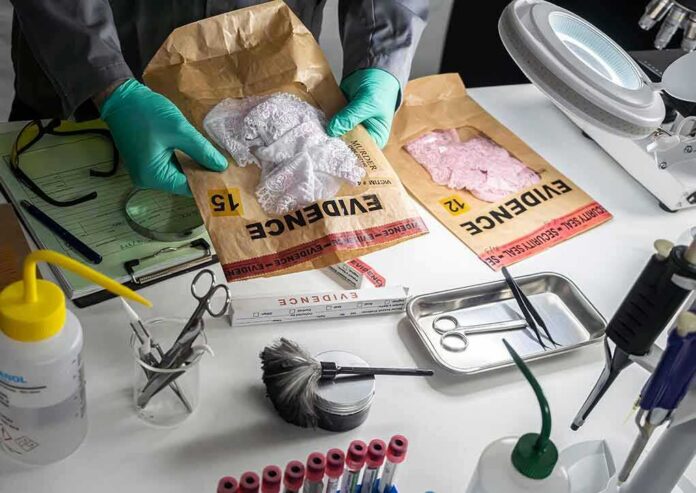
Cold cases are not solved by nostalgia; they yield when preserved evidence meets the right technology and disciplined investigators. Utah’s closure of the 1974 homicide of 17-year-old Melissa Ann Smith shows exactly how that convergence works, using a male-line DNA profile to connect two Utah murders and then anchor that link to Ted Bundy’s known genetic profile held by Florida authorities.
At a Glance
- Utah authorities closed the 1974 murder of Melissa Ann Smith after DNA linked her case to a second 1974 Utah victim and then to Ted Bundy’s archived profile.
- The key forensic bridge was a Y-STR profile, a male-line DNA signature shared by Smith’s evidence and evidence from Laura Aime’s murder; Aime’s profile matched Bundy’s known DNA.
- Summit County’s sheriff and attorney publicly endorsed the finding and the case closure after a multi-agency review.
- This outcome reflects a broader era of cold-case resolutions enabled by modern DNA methods and long-term evidence preservation.
What Was Established: A Two-Step Genetic Link That Closed a Case
Investigators reported a specific forensic chain. First, Utah County’s 1974 murder of Laura Aime yielded a DNA profile that matched Bundy’s archived reference in Florida—an assertion described in multiple outlets as a direct DNA match from preserved material. Second, Summit County’s 1974 homicide of Melissa Ann Smith produced a Y-STR profile—the male-line haplotype—that matched the Aime case. In other words, the Smith evidence matched Aime’s Y-chromosomal profile, and Aime’s case had independently matched Bundy’s known profile on file; Summit County then closed Smith’s case and attributed responsibility to Bundy.
Officials did not hinge closure on hype; they framed the genetic result within traditional investigative pillars—pattern, means, motive, and opportunity—and publicly endorsed the outcome. Sheriff Kacey Bates announced the closure, and Summit County Attorney Margaret Olson stated the evidence established Bundy’s responsibility for Smith’s murder. Multiple national and local news organizations reported the same basic sequence on the day of the announcement, giving the account breadth of independent coverage.
How Y-STR Evidence Functions—and Why It Fit This Case
Autosomal STR profiling—the workhorse DNA test—can uniquely individualize a suspect at high confidence when profiles are complete and clean. Y-STR typing is different. It captures short tandem repeat patterns on the Y chromosome, which sons inherit largely unchanged from their fathers, creating a patrilineal “signature.” That lineage signal is potent in male/female mixtures and degraded samples but, unlike autosomal STRs, often cannot distinguish between paternally related men without additional rapidly mutating markers or complementary evidence.
The trade-off is well characterized in forensic literature: Y profiles are valuable for detecting and associating male contributors in difficult samples, yet their evidential weight rests on how rare the haplotype is, how many loci were typed (including any rapidly mutating Y-STRs), and the presence of corroborating facts that narrow plausible paternal relatives. Evaluating such evidence demands context—victimology, geography, timeline, and known offender movements—so that a lineage-level link is not treated as a free-standing individual identification.
Why This Linkage Carries Investigative Weight Beyond the Molecules
Bundy’s activities placed him in Utah in late 1974; he targeted young women, operated across county lines, and used victim-disposal sites along Wasatch Front corridors. Those non-DNA facts, combined with Aime’s case linking directly to Bundy’s DNA and Smith’s case sharing the male-line profile with Aime’s, substantially compress alternative explanations. In practical cold-case work, the aim is not theoretical uniqueness in a vacuum but a convergent case narrative that stands on multiple legs—genetic association, offender presence and pattern, temporal proximity, and investigative records capable of surviving retrospective scrutiny. This is what Summit County meant by invoking pattern, means, motive, and opportunity alongside lab results.
The institutional actions match that confidence. The sheriff’s office and county attorney jointly closed Smith’s case; interagency partners in Summit, Salt Lake, and Utah counties contributed preserved evidence and historical files; and the Utah State Crime Lab handled modern testing. That is the infrastructure of a credible cold-case clearance in 2026: long-archived exhibits, validated methods, and multi-office review before a public conclusion.
Mechanics and Provenance: Preserved Evidence Meets Modern Tools
Both Utah murders date to the autumn of 1974, when biological sampling and storage were inconsistent by today’s standards. The advantage in this instance was twofold. First, investigators retained material sufficient to extract STR and Y-STR information decades later. Second, Bundy’s reference DNA remained accessible from Florida, creating an anchor for cross-case comparison. The reported workflow—develop STR in Aime’s case to connect to Bundy, derive a Y-STR haplotype in both Aime and Smith, and then align the male-line profiles—reflects standard practice when autosomal typing is partial or when male-specific signal helps separate contributors.
Cold-case strategy research supports prioritizing files precisely like these: homicides with preserved biological material, viable comparative references, and investigative avenues that can validate a genetic lead. Agencies “work smarter” by triaging which boxes to open first—cases where a tested sample can actually move the needle toward a clearance, as occurred here.
Here's a remarkable cold case story.
In 1974, 17-year-old Melissa Ann Smith was murdered in Utah.
Yesterday, exactly 52 years after her body was discovered, investigators announced they'd finally identified her killer: Ted Bundy.
Yeah, THAT Ted Bundy.
DNA evidence preserved…
— BluByU (@Udntnonutn) October 28, 2026
What Y-STR Can and Cannot Do—And Why It Still Closed the Loop
For readers fluent in DNA evidence, this outcome raises a fair conceptual point: a Y-STR match tags a paternal lineage, not a unique person, unless augmented by rapidly mutating Y-STRs or additional discriminators. That limitation is real, documented, and well-taught in forensic training and peer-reviewed work. It does not, however, negate an investigative conclusion when the lineage signal intersects with a directly matched autosomal profile in a sister case, and when historical facts fit a known offender’s movements and method. Authorities are not asking the public to accept a naked Y-STR coincidence; they are presenting a matched lineage between two co-located 1974 murders and a separate, direct link between one of those murders and Bundy’s reference DNA—then situating that within Bundy’s documented presence and pattern in Utah that season.
That framing also guards against a common error in sensational coverage: treating any male-line match as a standalone silver bullet. The science counsel is straightforward. Y-STR is powerful when it narrows candidates to a patriline, especially in historical or mixed samples; its individualizing power rises with more loci and rapidly mutating markers; and its probative value is maximized when combined with corroboration—time, place, modus operandi, and, as here, an anchored autosomal match in a companion case.
Why This Case Matters for Cold-Case Work Going Forward
Three lessons travel well beyond Bundy. First, evidence preservation is policy, not luck; properly stored biological samples from the 1970s can still yield probative DNA decades later. Second, interagency file-sharing is not bureaucracy—it is capability. The Smith and Aime link required county lines to blur in service of a single forensic question. Third, lineage DNA, thoughtfully used, can bridge across partial autosomal profiles, degraded evidence, or complex mixtures; it does not replace autosomal STRs but complements them in exactly the kind of constrained scenario cold cases present.
The families of victims live for this kind of clarity. Bundy was executed in 1989 and cannot be prosecuted for Smith’s murder, but closure is not a synonym for court; it is the ethically earned endpoint of a methodical review that clears away uncertainty. Utah’s teams showed how to reach it: save everything, revisit with better tools, and let converging lines of evidence—not mythology—carry the conclusion.
Sources:
washingtontimes.com, cnn.com, upi.com, cbsnews.com, adn.com, rmb.reuters.com, parkrecord.com, deseret.com, newsweek.com, tandfonline.com, pmc.ncbi.nlm.nih.gov, academic.oup.com, pubmed.ncbi.nlm.nih.gov
© whatnewsdaily.com 2026. All rights reserved.