

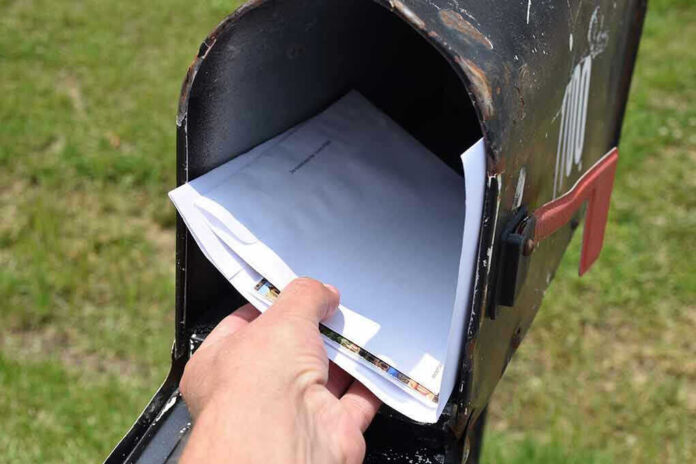
A closely divided Supreme Court just told Americans that ballots can keep rolling in after Election Day and still count.
Story Snapshot
- Supreme Court ruled 5–4 that federal law does not forbid states from counting mail ballots that arrive after Election Day if they are mailed on time.
- The case, Watson v. Republican National Committee, upheld Mississippi’s rule allowing absentee ballots postmarked by Election Day to arrive up to five business days later.
- Roughly 30 states and territories already use some form of mail-ballot grace period, so the ruling reaches far beyond Mississippi.
- Conservatives are now split between defending state control of elections and warning that late-counted ballots can erode trust in close races.
What Exactly Did The Supreme Court Decide?
The Supreme Court held that federal Election Day laws do not stop Mississippi from counting absentee ballots that are postmarked by Election Day but arrive up to five business days later.[5] Justice Amy Coney Barrett wrote the 5–4 opinion, stressing that federal statutes require the people’s choice to be made on Election Day, not for every envelope to be in government hands by midnight.[5] Under Mississippi law, no one can legally vote after Election Day, but officials may still receive and count properly postmarked ballots that show voters acted on time.[5]
Mississippi’s statute says absentee ballots in federal races must be postmarked on or before Election Day and received within five business days to count.[5] The Court said that rule does not conflict with the federal law that sets “the Tuesday after the first Monday in November” as Election Day for Congress and the presidency.[5] In the majority’s view, those federal laws fix the deadline for when voters must make their choice, but they do not micro-manage how states collect and count ballots that were cast by that day.[5]
Why This Matters Far Beyond Mississippi
This fight started when the Republican National Committee and other plaintiffs claimed a nineteenth century Election Day statute requires ballots to be both cast and received by that day.[3] A panel of the Fifth Circuit Court of Appeals accepted that argument and said Mississippi’s five-day grace period is preempted by federal law, creating a sharp split with earlier lower-court rulings in other states.[3] By reversing that reading, the Supreme Court not only revived Mississippi’s law but also signaled that similar grace-period systems around the country are legally safe for now.[5]
Roughly 30 states, the District of Columbia, and three U.S. territories already allow election officials to count mailed ballots that are sent by Election Day but come in afterward, usually within a short window.[2] One analysis estimated that in the 2024 cycle at least 750,000 such ballots were postmarked on time and arrived during grace periods, showing how many real voters could have been tossed out if the Court had gone the other way.[2] Some grace-period rules go back many decades and were used for military and other voters long before the recent battles over pandemic voting changes.[2]
Election Integrity Concerns From The Right
Justice Samuel Alito’s dissent warned that the ruling creates “a slurry of troubling election-law questions” and could damage public confidence in elections.[1] He and the other dissenters sided with the view that a single national Election Day means the government should stop receiving ballots that day, arguing that anything else stretches the word “day” and invites more litigation over voting windows.[3] For conservatives already uneasy about mass mail voting, their concern is that longer counting feeds suspicion, especially when results flip days after cameras stop rolling.
Republican activists had framed the case as part of a larger push to tighten mail-ballot rules, arguing that firm receipt deadlines reduce chances for fraud and error.[3] Some conservative legal voices now fear this decision will be used to attack efforts like stricter voter identification for mail ballots or laws that shorten counting periods.[8] At the same time, the ruling does not force any state to adopt grace periods; it simply says Congress did not forbid them. States that choose a “received by Election Day” rule remain free to keep it, which still lets red states draw a hard line if their voters demand it.[9]
How Patriots Should Read This Ruling
For constitutional conservatives, the ruling is a mixed bag. On one hand, the Court affirmed that states keep broad power over the “time, place, and manner” of federal elections when Congress has not clearly spoken, which many see as a win for federalism against one-size-fits-all mandates from Washington.[5] On the other hand, many grassroots Republicans see any counting after Election Day as a doorway to chaos, and they will view this decision as another elite move that ignores their demand for quick, clean results and tighter mail voting.[1]
In the Supreme Court today:
Supreme Court rules mail-in ballots arriving after Election Day can be countedhttps://t.co/RVEgzUYZuj
— Frank Amari (@FrankAmari2) June 29, 2026
Going forward, the real fight may shift from the courts to the statehouses. Even with grace periods upheld, lawmakers can still tighten rules by demanding stronger identification checks for mail voters, better tracking systems, cleaner voter rolls, and strict chain-of-custody rules for ballot handling.[3] For citizens who care about both honesty and access, the task now is to pressure state officials to pair any grace period with real transparency—clear deadlines, prompt reporting, and public audits—so that every legal vote cast by Election Day is counted, and Americans can see exactly how and when that happens.
Sources:
[1] Web – Supreme Court says states can count mail ballots that arrive after …
[2] Web – The Supreme Court upholds grace periods for mail-in ballots, siding …
[3] Web – Supreme Court Arguments Involved Misleading Claims About Mail …
[5] YouTube – Stakes of Supreme Court case on grace period for mail-in ballots
[8] Web – The Supreme Court rules that states can count mail-in ballots that …
[9] Web – Extended Absentee Ballot Receipt Deadlines: Watson v RNC
© whatnewsdaily.com 2026. All rights reserved.