
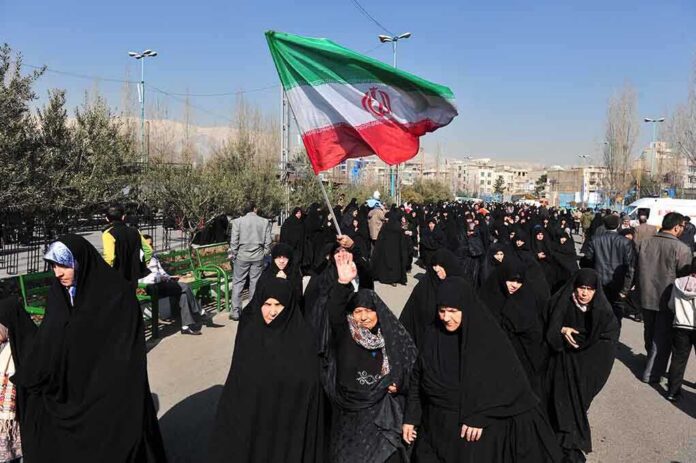
Iran’s six‑day funeral for Ayatollah Ali Khamenei is drawing vast crowds and raising fresh questions about how modern regimes use grief as a show of power.
Story Snapshot
- A six‑day funeral route through Iran and Iraq is designed to project strength after Khamenei’s killing.
- Tehran officials talk about **tens of millions** of mourners, while many foreign reporters see far fewer.
- The delayed burial and the new leader’s absence highlight uncertainty at the top of Iran’s system.
- The event shows how governments, including Iran, turn public mourning into a political tool in times of war.
A funeral turned into a show of power
The government in Iran has built Khamenei’s funeral into a six‑day journey across key religious and political cities, not just a simple burial. The route starts with huge gatherings in Tehran, then moves to the shrine city of Qom, crosses into Iraq for ceremonies in Najaf and Karbala, and ends in Mashhad, Khamenei’s birthplace and home to a major holy site. Officials openly say they want “millions” in the streets and are offering transport, food, and places to stay to push turnout higher.
Iranian leaders are not hiding the political goal. Khamenei was killed in joint United States and Israeli airstrikes during a wider war, and state media frames the funeral as proof the system is united and strong in the face of foreign enemies. Crowds chant “death to America” and call for revenge as they pass his flag‑draped coffin and those of family members killed with him. The message is clear: mass mourning equals regime legitimacy, at home and across the Shiite Muslim world.
How big are the crowds, really?
Tehran’s mayor, Alireza Zakani, says the capital could see nearly **20 million** people over the week, which would be the largest gathering in the city’s history. Officials also claim that up to 8–10 million people may join the final burial in Mashhad. Iranian state television and many regional outlets loop images of packed squares and wide roads full of black‑clad mourners watching the coffin pass.
Foreign reporters and some Western outlets see something different. A BBC correspondent on the ground said turnout in parts of Tehran looked “less than expected,” with crowds in the “tens of thousands,” not millions. Time magazine and other Western sources also use phrases like “tens of thousands” or “large crowds,” avoiding the huge numbers pushed by Iranian media. This split over crowd size fits a familiar pattern from past funerals for figures like General Qasem Soleimani, where officials claimed tens of millions and outside analysts estimated far fewer.
Unusual timing and missing faces
The funeral also stands out because of its timing. Khamenei was killed on February 28, yet the main funeral ceremonies did not begin until early July, almost four months later. In Islamic tradition, burial normally happens within a day. Iranian officials say war conditions and security concerns delayed a full public send‑off until a ceasefire and travel plans could be set. That gap makes the event feel less like a spontaneous national outpouring and more like a carefully planned political theater.
The new Supreme Leader, Khamenei’s son Mojtaba, is another question mark. Reports say he was injured in the same airstrikes, and he has been largely absent from public view, including from the largest funeral events so far. In a system built on the image of a single, strong religious leader, that absence fuels rumors about his health and about who really holds power now. It weakens the picture of seamless, confident succession that the funeral is supposed to send to the world.
Managed mourning in an age of mistrust
Iran is not the only country that uses funerals this way. Political scientists who study authoritarian systems find that states often inflate crowd sizes at big events by three to five times compared to independent estimates. This happened at the funerals of Ayatollah Ruhollah Khomeini and General Soleimani, when officials spoke of more than ten million mourners, but satellite images and outside reporting suggested hundreds of thousands to maybe a million.
Iran deepens ties with Houthis, Tehran envoy reappears in Yemen amid conflict escalation
Iran’s regime is feeling empowered. The funeral events of the late Supreme Leader Ali Khamenei are continuing in the region, and his body is expected to go from Qom to Iraq this week.…
— Alex 🇺🇸 (@A_L_E_X_V_E_G_A) July 7, 2026
For many Americans, both conservative and liberal, this story feels familiar even if it is happening far away. They watch another government use media control, security lockdowns, and emotional language to claim that “the people” stand united behind leaders who seem more focused on staying in power than fixing daily problems. At home, many already worry that elites in Washington, on both sides, play similar games with crowds, crises, and fear to hold on to control. Khamenei’s funeral shows how powerful that script can be—and how hard it is to trust any government’s numbers when grief becomes a stage.
Sources:
youtube.com, cnbc.com, time.com, bbc.com, instagram.com, nbcnews.com, nytimes.com, facebook.com, cnn.com
© whatnewsdaily.com 2026. All rights reserved.