

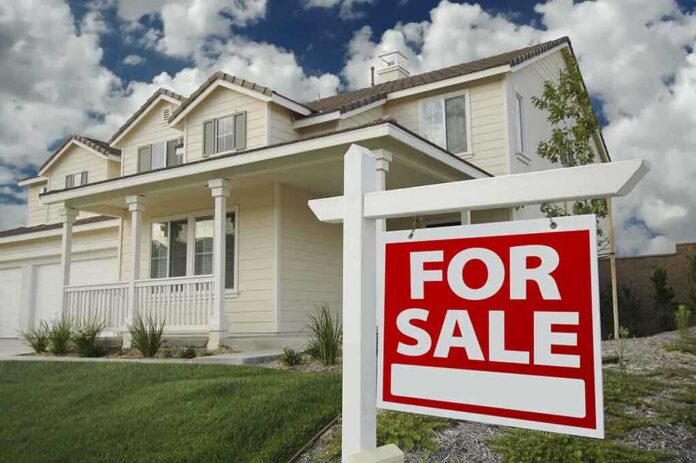
America’s housing “affordability math” now says prices must fall or wages must jump, yet leaders in both parties still cheer rising home values.
Story Snapshot
- Price-to-income near bubble-era levels raises alarm about access to the American Dream [9].
- Analysts split: some see stability, others warn demand and savings look fragile [10][9].
- Data shows most metros still rising, but sales pace and savings strain many families [10][9].
- Low-rate mortgages reduce forced selling, which may slow, not stop, a reset [10].
Affordability Metrics Flash Red, Even As Prices Hold
Bloomberg’s affordability math, cited by market watchers, says home prices must drop roughly 15 to 20 percent, or incomes must rise about 15 percent, to restore balance [9]. The national price-to-income ratio sits near 4.3, a level seen near the 2006 peak, which alarms many buyers and renters [9]. This is the core tension. Prices look firm in many areas, but the cost-to-paycheck gap grows. Families see the dream of owning a home moving further away, even as elected leaders praise rising equity.
ClearValue Tax’s review shows national prices up about 2 percent year over year and 223 of the 300 largest metro areas still rising, which argues against a nationwide crash today [10]. At the same time, the same data shows a thin rise in supply and a market that feels stuck. Nearly a quarter of homes still sell above list, showing pockets of strong demand, but that does not fix the basic math for new buyers facing higher rates and record prices in many cities [10].
Locked-In Mortgages Change The Risk, Not The Pain
Analysts who manage large rental portfolios say today is not 2008 because most loans are fixed rate. About 95 percent of current mortgages are fixed, which cuts the risk of a wave of forced selling if rates rise or jobs weaken [10]. That lock-in keeps many owners from listing their homes. Fewer listings support prices, but fewer listings also freeze mobility. This protects banks and sellers, yet it squeezes young families who cannot break into the market.
That freeze has a second cost. When owners stay put to keep their low rate, fewer trade-up homes hit the market. First-time buyers then compete over too few entry homes. The result is a slow grind: prices resist big drops, but real affordability worsens. This split is why some experts forecast flat prices over five to ten years. Flat prices still mean losses after inflation, and they do nothing to clear the wage-to-price gap for working families [10].
Warning Signs: Savings Strain And Transaction Risk
Market bears point to household stress. Commentators citing federal data note the personal savings rate has slipped near lows last seen before the 2007 to 2008 bust, which raises concern about a hit to demand if job growth slows or debt costs rise [9]. They also cite the late 1970s to early 1980s, when home sales collapsed by about half even as prices held, due to a severe affordability squeeze. That pattern could repeat if rates stay high and wages lag [10].
The US housing market just sent another warning signal.
New home sales collapsed to 580,000 in May. The forecast was 638,000. A miss of 58,000 homes. Previous month was 626,000.
Here is the number that puts this in context. In January 2022 new home sales were above 1,000,000… pic.twitter.com/rNqwOWKP8v
— Neel (@NeelMacro) June 24, 2026
The Federal Reserve Bank of Dallas reviewed real-time price models and found recent data pointed to softer real price growth, not a rapid decline, and even showed upside surprises in later quarters of 2025 [11]. That supports a “slow bleed” view rather than a hard crash. Yet a slow bleed still hurts buyers. It stretches saving timelines, delays family plans, and feeds the view that the system favors asset owners over wage earners. That anger spans the right and the left.
Politics, Perception, And The American Dream
Political voices often celebrate rising home values as proof of strength. Commentators also note that some leaders prefer higher prices, which may ease voter pain for current owners but deepens it for renters and first-time buyers [10]. Many readers see a pattern: powerful interests benefit from asset inflation while workers face higher rents, higher insurance, and rising taxes. That fuels the belief that the system serves insiders first, no matter which party is in charge.
What should households watch now? First, the wage-to-price gap. If incomes do not catch up, pressure builds for a reset or a long stagnation. Second, sales volumes. A sharp drop in transactions without a price crash signals a freeze that locks out new buyers. Third, savings and credit stress. If savings keep falling and debt delinquencies rise, demand weakens. Today’s data leans toward a long affordability squeeze, not an immediate crash, but the squeeze is itself a crisis [11][10][9].
What Would Ease The Squeeze
Restoring balance needs more small, entry-level homes, simpler building rules, and lower hidden fees. Faster permitting and lower impact costs could help builders add cheaper units. Targeted repairs to zoning can open land for duplexes and townhomes near jobs. These ideas do not pick sides. They back work, family, and ownership. Until that happens, the housing market will likely drift: prices sticky, listings tight, and the American Dream on hold for millions.
Sources:
[9] Web – Michael Burry has a blunt message on the stock market for 2026
[10] Web – Home Price to Income Ratio – Updated Chart – LongtermTrends
[11] Web – Limited Evidence California is Facing New Housing Bubble
© whatnewsdaily.com 2026. All rights reserved.