
A human-caused mega-fire has exploded into the largest active wildfire in America, ripping through southern Utah while officials tighten controls on everyday freedoms and still cannot say exactly who started it.
Story Snapshot
- Cottonwood Fire is the largest active wildfire in the US, burning over 70,000–90,000 acres with 0% containment.
- Officials say the blaze is human-caused but admit the exact cause and culprit are still under investigation.
- Governor Spencer Cox declared a state of emergency and handed statewide fireworks power to the state forester.
- Hundreds of properties may be damaged or destroyed while full damage numbers remain unknown.
Cottonwood Fire: A Human-Caused Blaze Turns Into America’s Largest Wildfire
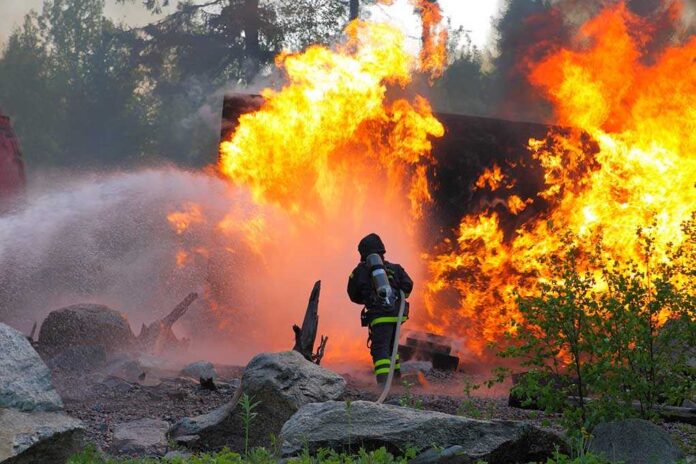
Utah’s Cottonwood Fire has exploded into the largest active wildfire in the United States, racing through tinder-dry forests in Beaver and Piute counties and blackening more than 70,000 to over 90,000 acres with zero containment.[5] Local mapping and news footage show a fast-moving wall of flame pushed by wind gusts near 45 miles per hour and humidity in the single digits, leaving firefighters with few options to stop the spread as the fire jumps ridgelines and threatens homes and critical infrastructure.[6][7]
State and local fire officials classify the Cottonwood Fire as human-caused, meaning someone’s actions, carelessness, or equipment started the blaze rather than lightning.[1][8] At the same time, those same officials say the “exact cause” is still under active investigation, and some national outlets continue to note that the cause is “still under investigation” or “has yet to be determined,” which fuels public doubt about the story they are hearing.[3][5] This gap between blaming humans and naming a clear culprit frustrates residents who want accountability, not vague labels.
Emergency Powers, Fireworks Bans, and Questions About Overreach
Utah Governor Spencer Cox declared a state of emergency as the Cottonwood Fire surged, warning it could become the most destructive blaze in state history after tearing through a private ski resort area lined with cabins and condominiums.[9][10] To reduce new ignitions before Independence Day, Cox signed an order that shifts fireworks control from local communities to the state forester, giving a single state official power to restrict or outright ban fireworks across Utah through July 5 instead of letting city councils make those calls.[3][6]
National and local reports stress that Utah is facing one of its most severe wildfire seasons in recent memory, with hundreds of fires already this year and roughly three-quarters of them traced to human activity.[5][16] Fire leaders argue that “one human-caused fire is one too many” and say stricter rules on fireworks and other recreation are needed.[3][15] Many conservative residents accept commonsense safety limits but grow uneasy when temporary emergency orders bypass normal local decision-making, especially when restrictions hit family celebrations of the nation’s 250th anniversary while investigators still have not named who started this particular fire.[6]
Communities Under Threat While Damage Numbers Stay Murky
The Cottonwood Fire has already scorched Eagle Point Resort in Beaver County, destroying multiple cabins and structures and forcing mandatory evacuations in nearby communities such as Eagle Point, Merchant Valley, HiLo Estates, and Arrowhead Summer Homes.[1][9] Fire officials and Governor Cox suggest that more than 100 properties may have been damaged or destroyed, yet detailed counts of homes and businesses lost remain “unknown” as heavy smoke and dangerous conditions keep assessment crews out of the hardest-hit zones.[4][9]
Families in towns like Marysvale and Junction are told to remain on “ready” status for evacuation, watching the fire line creep closer while listening to changing orders from state and federal teams.[3] Residents see power shutoffs, highway closures, and forest shutdowns arrive quickly, but they still lack clear information about how many neighbors have lost everything and what support will follow once the flames die down. That uncertainty, combined with the human-caused label and ongoing investigation, adds to anger toward those who started the fire and toward systems that seem slow to deliver straight answers.
Extreme Fire Weather, Human Ignition, and the Bigger Pattern
Fire scientists note that Utah’s wildfire risk is now driven by two forces at once: more dangerous fire weather and stubborn human behavior. Long-term research in Utah shows that hotter temperatures and longer fire seasons are linked to rapid growth in burned area, especially in dry forest and brush zones like those now burning around Fishlake National Forest.[14][17] At the same time, state data from recent years confirm that the majority of Utah’s wildfires start with people, not lightning, including campfires, debris burns, machinery, and fireworks.[12][15]
Three firefighters killed, two injured in Cottonwood Fire burnover at Utah-Colorado border Saturday. The 144-square-mile blaze highlights escalating wildfire danger across the American West. #WildlandFire #FireSafety #ColoradoUtah
— WECU News (@WECU_News_First) June 29, 2026
National climate and wildfire data show that, across the West, the number of fires each year has stayed fairly steady while the size and intensity of the biggest fires have climbed, driven by hotter, drier, windier conditions.[17][18] For conservative communities, that means two hard truths intersect: global fire weather is getting worse, but many of the sparks still come from everyday choices close to home. The Cottonwood Fire, labeled human-caused yet still not fully explained, now stands as a dramatic example of how one act can combine with extreme weather to threaten lives, property rights, and the freedom to enjoy America’s forests safely.
Sources:
[1] YouTube – Largest wildfire in the US spreads through tinder-dry forest in Utah
[3] Web – Cottonwood Fire, the largest in the US, spreads overnight, forcing …
[4] Web – Uncontained Cottonwood Fire burns 92,000 acres in Southern Utah
[5] YouTube – Utah’s Cottonwood Fire could be the worst in state’s history
[6] Web – Residents on notice as fast-moving fire in Utah, the largest in the …
[7] YouTube – Cottonwood Fire, nation’s largest wildfire, burns 92,000 acres in …
[8] Web – Nation’s largest wildfire grows to over 70,000 acres in Southern Utah
[9] Web – Photos capture nation’s largest Cottonwood Fire, its extensive damage …
[10] YouTube – The “Cottonwood Fire” is Becoming One of the Most Destructive Fires …
[12] YouTube – Cottonwood Fire expands to over 27,000 acres, determined as …
[14] Web – July-August human-caused wildfire comparisons: 159 in 2021 471 …
[15] Web – [PDF] Historical patterns of wildfire ignition sources in California …
[16] Web – [PDF] Large projected increases in area burned and wildfire frequency …
[17] Web – [PDF] All About Wildfires – Natural History Museum of Utah
[18] Web – More than 75% of Utah’s wildfires are human-caused, which means …
© whatnewsdaily.com 2026. All rights reserved.