
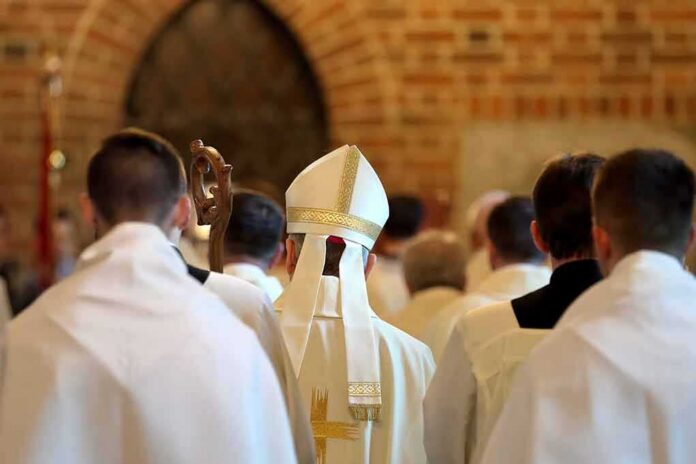
A secret deal between the Vatican and Beijing has just produced another Chinese bishop who owes his office to both the Pope and the Communist Party.
Story Snapshot
- Pope Leo XIV approved a new Chinese coadjutor bishop under the confidential Vatican–China agreement.
- The Chinese Communist government publicly backed and consecrated the same bishop in its state-controlled church.
- The 2018 Provisional Agreement lets Beijing propose bishops while the Pope claims final say, but the text remains secret.
- Critics across the political and religious spectrum worry this deal trades church freedom for smoother ties with an authoritarian regime.
New bishop in China approved by Pope and Communist Party
Pope Leo XIV recently approved the candidacy of Francis Xavier Duan Yongkun as coadjutor bishop of Bameng, a diocese in Inner Mongolia, under the Vatican’s Provisional Agreement with China. A coadjutor bishop is a kind of “bishop-in-waiting” who will take over the diocese when the current bishop dies or retires. The Holy See said Duan’s ordination followed approval of his candidacy “within the framework” of the deal, and Chinese authorities also recognized the ceremony inside their official Catholic structure.
This latest appointment came just days after another Chinese priest, Father Joseph Chang Yanfeng, was consecrated as bishop of Chifeng, also in Inner Mongolia. The Vatican stated that Pope Leo approved Chang’s appointment on June 15, again “within the framework of the provisional agreement” with Beijing. With these ordinations, a growing number of bishops in China now receive their authority through a process shaped by both Rome and the Chinese Communist Party, not solely by the Catholic hierarchy.
How the secret Vatican–China deal works
The Holy See and the Chinese government first signed the Provisional Agreement on the appointment of bishops in 2018, calling it the result of years of negotiation and a step toward unity among Chinese Catholics. The text has never been made public, but human rights reporting and Vatican summaries say Chinese officials propose bishop candidates and the Pope has the right to veto them. In exchange, the Vatican agreed not to name bishops in China without first seeking approval from Beijing’s authorities.
Since 2018, the agreement has been renewed multiple times, most recently for another four years in October 2024, and now runs to 2028. During that time, at least fifteen bishops have been ordained under its terms, including new bishops in Inner Mongolia and a restructured diocese in Zhangjiakou that Pope Leo created by suppressing two older dioceses. Supporters say the deal helps heal the split between the underground Church loyal to Rome and the state-run Church loyal to the Communist Party, but the secrecy has fueled distrust among both Catholics and secular observers.
Why this alarms people on both left and right
Many conservatives in the United States already see global elites, including church leaders, as too soft on authoritarian regimes and too eager to cut deals that ignore basic freedoms. For them, a Catholic bishop chosen through a process shaped by the Chinese Communist Party looks like another example of powerful institutions trading principles for access and influence. They worry the same mindset that tolerates censorship and persecution abroad also drives policies at home that ignore ordinary citizens.
Many liberals, meanwhile, focus on human rights and the growing gap between the powerful and the vulnerable. They note that China tightly controls religion and has a record of crushing dissent. They question whether any real “freedom of religion” can exist when a one‑party state helps pick church leaders. For people across the political spectrum who already feel the “deep state” and global elites run things for themselves, the idea of bishops approved in a back‑room deal between Rome and Beijing deepens fears that institutions no longer stand up to concentrated power.
Tension between religious freedom and political control
The Catholic Church teaches that bishops should be chosen free from state pressure, yet the China agreement formally gives government officials a role in the process. The Vatican argues the Pope still has the final word and that, in practice, this deal prevents worse outcomes, such as bishops appointed only by the Party, with no papal input. Human Rights Watch and other groups counter that allowing Beijing to propose candidates risks turning bishops into quasi‑state officials, especially in a system where party loyalty is key to career advancement.
Pope Leo XIV appointed Francis Xavier Duan Yongkun as Coadjutor Bishop of Bameng on 15 June, in the Inner Mongolia Autonomous Region, within the framework of the Provisional Agreement between the Holy See and the People’s Republic of China.https://t.co/bo6ZAI56y7
— Vatican News (@VaticanNews) July 29, 2026
There have already been flashpoints. In one case, the Vatican said China installed a bishop in a different diocese without following the spirit of the agreement, calling the move a violation of the deal. At other times, Rome has chosen to accept bishops first appointed by Chinese authorities, later “regularizing” them to avoid open conflict. Each episode feeds the concern that a secret agreement lets two powerful institutions sort things out privately, while faithful Catholics and ordinary citizens are left guessing who truly leads the Church and whose interests come first.
Sources:
lifesitenews.com, catholicnewsagency.com, thecatholicherald.com, infovaticana.com, youtube.com, ncregister.com, apnews.com, en.wikipedia.org, reuters.com, joansrome.wordpress.com, ncronline.org, ewtnnews.com, archbalt.org
© whatnewsdaily.com 2026. All rights reserved.