

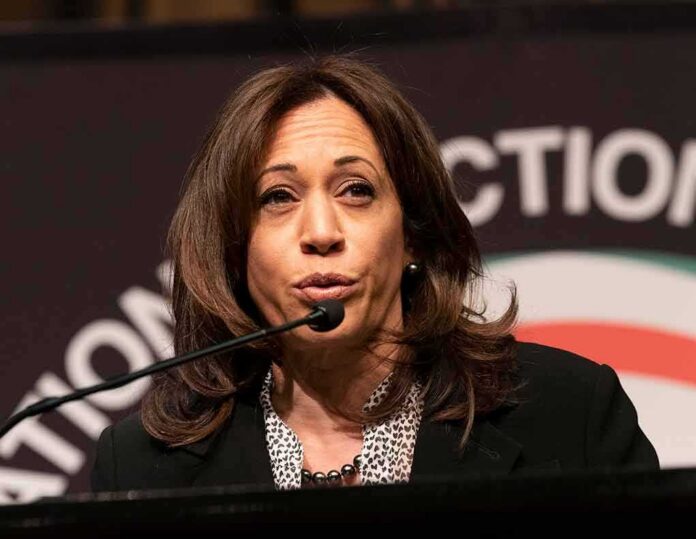
Kamala Harris told a New Hampshire crowd that Democrats should expand the Supreme Court to 13 justices and “be ruthless” about structural reform if they win.
Story Snapshot
- Harris backed expanding the Supreme Court to 13 justices and tied it to broader reforms.
- She urged a fresh look at the Electoral College and said the popular vote should matter.
- She listed statehood for Puerto Rico and Washington, D.C., and overturning Citizens United as goals.
- She defined “ruthless” as firm accountability, not cruelty, in using power if elected.
Harris Calls For A 13-Justice Supreme Court
Kamala Harris told attendees in Manchester, New Hampshire, that “we have to expand the Supreme Court” and proposed 13 justices. She linked the number to the count of federal circuit courts and framed the idea as part of needed “structural work.” Her remarks came during a recorded event focused on reproductive rights and during campaign stops for New Hampshire Democrats. The comments were captured on video and summarized by local reporting that highlighted court expansion as a first priority.
Harris’s stated link between 13 justices and 13 circuits drew attention because the Constitution does not set a fixed number of justices, and Congress has changed the Court’s size in the past through ordinary law. Historical reviews note the Court’s size shifted multiple times in the 1800s, often alongside political fights and national growth. That record shows expansion is legally possible, though politically charged in practice.
Broader Structural Agenda And The “Ruthless” Framing
Harris described a wider program beyond the Supreme Court. She said Democrats should “take a critical look at the Electoral College,” and in a separate setting said “the popular vote has to matter.” She also cited statehood for Puerto Rico and Washington, D.C., and overturning the Citizens United decision as goals. She told the audience, “we have to be ruthless,” and defined that as being uncompromising about accountability and consequences, not being cruel.
Her “ruthless” line reflects a hard-edge promise to use power if voters hand it to Democrats, which will rally some and alarm others. Many Americans on both left and right already worry that elites bend rules to get what they want. A pledge to change the highest court and rework election rules touches those nerves. Supporters will see a system fix; critics will see a bid to lock in control. The divide will likely sharpen if Democrats formalize the plan.
What Is Clear And What Remains Unspecified
Harris’s speech laid out a clear direction but left out key steps. She did not present bill text, a timeline, or a path to seat four new justices. She did not say how nominees would be chosen or how the Senate would handle confirmations. On the Electoral College, she did not endorse one method, such as a constitutional amendment or a state compact. These gaps matter because any change to the Court or to electing presidents demands precise legal and political plans.
Historical and legal context shows Congress can change the Court’s size by statute. Scholars also note prior expansions often mixed practical and political aims. That history gives talking points to both sides. Backers can say change is lawful and not new. Opponents can say past changes were political and risk more tit-for-tat moves now. Voters who feel let down by Washington may ask a basic question: will any of this lower prices, make streets safer, or clean up corruption?
Why This Moment Feels High Stakes
Today’s fight sits inside a larger struggle over trust. Many conservatives blame years of liberal policies for weak borders and high costs. Many liberals blame “America First” policies for rising inequality and cuts to the safety net. Yet more people in both camps now agree on one thing: the system feels rigged by powerful insiders. Harris’s plan meets that anger with a promise to change the rules. The risk is that each side, when in power, keeps changing them back.
Limits And Next Steps To Watch
Published reports and the event video establish Harris’s statements and priorities. They do not show a formal Democratic Party platform adopting every item, nor do they provide a detailed legislative roadmap. Watch for bill filings, co-sponsors, and committee hearings that would signal a real push. Also watch for a defined Electoral College plan, since a constitutional amendment is difficult and interstate compacts face hurdles. Those concrete steps will tell voters how serious this agenda is.
Sources:
thegatewaypundit.com, patch.com, newhampshirepoliticalreporter.com, youtube.com
© whatnewsdaily.com 2026. All rights reserved.