
President Trump’s blunt order to “shoot and kill” mine-laying boats in the Strait of Hormuz is a reminder that a single chokepoint—and a handful of small craft—can rattle the world’s economy overnight.
Story Snapshot
- Trump said he directed the U.S. Navy to target boats laying mines in the Strait of Hormuz and to accelerate mine-clearing operations.
- The announcement comes during the eighth week of a U.S.-Iran war and after reports that Iranian mining has complicated navigation and reopening efforts.
- U.S. forces recently destroyed 10 Iranian mine-laying vessels within minutes, according to reporting cited in the research.
- Mine clearance could take months, keeping pressure on oil markets, shipping insurance, and consumer prices.
Trump’s Order: Clear Rules in a High-Stakes Waterway
President Donald Trump announced on April 23, 2026—via social media—that he directed the U.S. Navy to “shoot and kill” boats planting mines in the Strait of Hormuz, while pushing for faster mine-clearing operations. The research indicates Trump also tied passage through the strait to U.S. approval, effectively treating Hormuz as a controlled military corridor during active hostilities. The stated aim is deterrence: stop new mines from being laid while clearing existing ones.
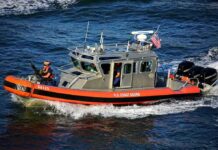
The key detail is how targeted the directive is: mine-laying craft, often described as small Iranian boats capable of quickly deploying mines, are central to the tactic. That matters because the strait’s strategic importance does not depend on large fleets; it depends on whether commercial shipping believes the water is safe. If mines continue appearing faster than they can be removed, global shipping companies may reroute, pause, or demand higher premiums—costs that cascade into prices Americans pay.
Why Hormuz Matters: Oil, Inflation, and the “Kitchen-Table” Impact
The Strait of Hormuz is widely described in the research as a critical energy chokepoint, with estimates that roughly 20–30% of global oil flows through it. When that lane is mined or treated as unsafe, the economic effect can be immediate: higher crude prices, higher fuel costs, and more inflation pressure across transportation and manufacturing. Even voters who tune out foreign policy feel it at the gas pump and in delivery surcharges.
The research also underscores a practical challenge: mine-clearing is slow, dangerous work that can take months, with some reports citing as long as six months. That timeline matters because it turns a military operation into an economic one. A prolonged clearance window can keep risk priced into oil and maritime insurance even if fighting calms down. In other words, the shock does not end when a statement is posted; it ends when shipping lanes are verifiably safe again.
Iran’s Asymmetric Tactic: Small Boats, Big Leverage
Iran’s approach, as summarized in the research, relies on asymmetric warfare—fast-attack craft and mines—rather than trying to match U.S. naval power ship-for-ship. Mines are comparatively cheap, hard to detect, and psychologically effective because a single strike on a commercial tanker can freeze traffic. The research notes the region’s history with these tactics dating back to the 1980s “Tanker War,” when mines and small-boat harassment became tools against more advanced navies.
One striking claim in the research is that Iran has struggled with the consequences of its own mining—reportedly having difficulty locating all mines it deployed. That detail highlights a broader reality of government decisions in wartime: actions meant to gain leverage can spiral into self-inflicted damage. For global markets, it means uncertainty persists even if one side wants the situation stabilized, because the mines themselves remain a physical hazard independent of politics.
Escalation Risks and Accountability Questions at Home
The research describes this moment as an escalation inside an already ongoing conflict, with no clear deadline laid out for negotiations. It also cites recent events in which U.S. forces destroyed 10 Iranian mine-laying vessels within minutes, reinforcing that the U.S. posture is not just rhetorical. Militarily, that may deter additional mining attempts. Politically, it also raises the stakes for preventing miscalculation—because rapid engagements in confined waters can widen a war unexpectedly.
Trump orders US Navy to destroy boats laying mines in Hormuz https://t.co/rgt8pvIFqX pic.twitter.com/wkP9C2PUez
— Insider Paper (@TheInsiderPaper) April 23, 2026
Domestically, the episode lands amid a broader frustration shared by many Americans—left and right—that Washington often reacts late, spends heavily, and explains poorly. Conservatives tend to prefer clear deterrence and protection of vital trade routes, but they also worry about open-ended commitments and the inflationary consequences of global instability. Liberals may focus on escalation and humanitarian risk. What is clear from the available reporting is that the strait’s security is now directly tied to U.S. enforcement decisions, and the economic costs will track the pace of mine clearance.
Sources:
Trump says US destroyed 10 Iranian mine-laying vessels, warns more to follow
ABC News Video: Trump orders Navy to “shoot and kill” boats laying mines in Strait of Hormuz