
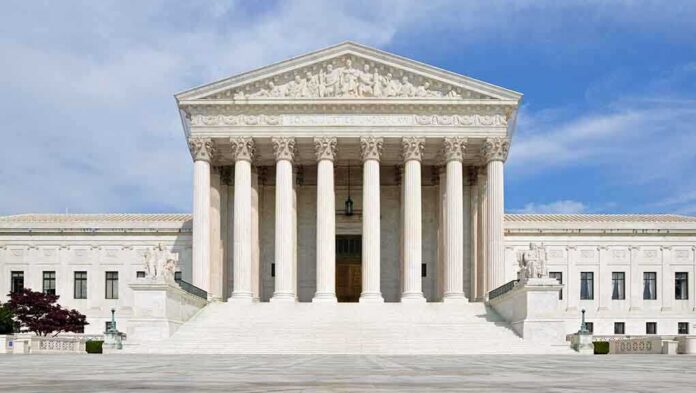
Three Supreme Court justices issued a stark warning that a 6-3 majority decision striking down President Trump’s emergency tariffs dangerously limits presidential power to defend America against urgent foreign threats like drug trafficking and economic warfare.
Story Highlights
- Supreme Court ruled 6-3 on February 20, 2026, invalidating Trump’s tariffs imposed under emergency powers to combat fentanyl trafficking and trade deficits
- Justices Thomas, Alito, and Kavanaugh dissented, arguing the majority “handcuffs” the president’s ability to respond to national security emergencies
- The ruling immediately halts tens of billions in tariff revenue and triggers refund claims from importers
- Dissenters warned that “context and common sense” support tariff authority under existing law, despite majority’s constitutional concerns
Supreme Court Strikes Down Emergency Tariffs in Split Decision
The Supreme Court delivered a major blow to President Trump’s trade agenda on February 20, 2026, ruling 6-3 in Learning Resources, Inc. v. Trump that his emergency tariffs exceeded presidential authority. Chief Justice Roberts authored the majority opinion, joined by Justices Sotomayor, Kagan, Jackson, Gorsuch, and Barrett. The decision invalidated tariffs Trump imposed under the International Emergency Economic Powers Act (IEEPA) to combat fentanyl trafficking from Canada, Mexico, and China, as well as trade deficits threatening U.S. manufacturing. The ruling represents an unusual conservative split, with Trump appointees Gorsuch and Barrett siding against the administration’s position on executive power.
Dissenters Warn of Crippled Presidential Authority
Justices Thomas, Alito, and Kavanaugh issued a forceful dissent arguing the majority improperly restricts presidential power to address urgent foreign threats. Justice Kavanaugh emphasized that “context and common sense” demonstrate IEEPA’s authorization to “regulate importation” implicitly includes tariff authority during declared emergencies. The dissenters contended that while the statute does not explicitly mention “tariffs,” the power to regulate imports necessarily encompasses the power to impose duties on those imports. This interpretation, they argued, aligns with decades of executive practice in managing national security crises and economic threats that require swift, decisive action beyond normal legislative processes.
Major Questions Doctrine Limits Emergency Powers
The majority applied the major questions doctrine, requiring clear congressional authorization before presidents can exercise vast economic power affecting billions of dollars in trade. Chief Justice Roberts emphasized that IEEPA does not provide explicit authority for “unlimited” tariffs, and such sweeping economic measures require unambiguous congressional delegation. The ruling noted Congress has historically granted tariff authority through specific statutes with defined limits, not through general emergency powers. This reasoning prioritizes constitutional separation of powers, placing tariff authority firmly within Congress’s domain under Article I. The decision limits future presidents’ ability to use IEEPA for broad trade actions, confining the law to its historical uses like sanctions and asset freezes.
Timeline of Trump’s Liberation Day Tariffs
Shortly after his 2025 inauguration, President Trump declared national emergencies under IEEPA citing drug influx and trade deficits as threats to national security and the economy. On April 2, 2025, he announced “Liberation Day” tariffs including a 10% baseline on most imports, 25% on Canadian and Mexican goods tied to fentanyl trafficking, and additional levies on China. Trump characterized these measures as essential tools for national defense, claiming they deterred international conflicts and protected American manufacturing jobs. Learning Resources, Inc. and other importers filed lawsuits challenging the tariffs as exceeding statutory authority, setting up the constitutional showdown that culminated in the February 2026 Supreme Court decision.
Immediate Economic and Political Fallout
The ruling immediately invalidates tens of billions of dollars in tariff collections and triggers waves of refund lawsuits from importers who paid duties under the now-defunct orders. Trump called the case “one of the most important in history,” warning that stripping presidential tariff authority leaves America economically vulnerable and weakens negotiating leverage with adversaries. Trade deals Trump negotiated with the EU, Japan, and South Korea face uncertainty as the administration lacks the emergency authority it previously wielded. The decision forces the White House to seek congressional approval for tariff actions or rely on narrower statutory authorities like Section 232, which covers specific national security concerns but lacks IEEPA’s breadth for addressing economic emergencies.
Constitutional Principles Trump Political Alignment
The conservative split reveals tensions between deference to executive authority in foreign affairs and strict adherence to constitutional limits on presidential power. Justices Gorsuch and Barrett, both Trump appointees, prioritized constitutional structure over political alignment, joining liberal justices to constrain executive overreach. This reflects a growing judicial skepticism toward broad delegations of power that blur separation of powers boundaries, even when limiting a president supported by the dissenting justices. The major questions doctrine, increasingly deployed by the Court, represents a check on administrative state expansion and presidential unilateralism. For conservatives who value constitutional governance and limited government, this decision upholds founding principles despite short-term policy setbacks.
Long-Term Impact on Presidential Emergency Powers
The decision establishes precedent limiting IEEPA to its historical scope of sanctions, asset freezes, and targeted economic measures rather than sweeping tariffs. Future presidents seeking broad trade authority must obtain explicit congressional authorization, returning tariff policy to the legislative branch as the Constitution envisions. This may force Congress to act if national security genuinely requires tariff tools, providing democratic accountability currently absent in executive unilateralism. Trade lawyers advise clients that IEEPA no longer provides lawful authority for tariffs, fundamentally reshaping import compliance strategies. The ruling tests whether Congress will grant presidents clearer emergency tariff powers or maintain legislative control over this constitutionally assigned function, with implications for how America responds to economic threats from China and other adversaries.
Sources:
SCOTUSblog – Supreme Court Strikes Down Tariffs
Justia – Learning Resources, Inc. v. Trump Supreme Court Case
TIME – Supreme Court Tariffs Ruling Trump
Politico – Trump Tariffs Supreme Court Ruling
Thompson Hine – U.S. Supreme Court Invalidates IEEPA as Lawful Authority to Impose Tariffs
U.S. Supreme Court – Official Opinion Learning Resources, Inc. v. Trump
CalMatters – Trump Tariffs Supreme Court